
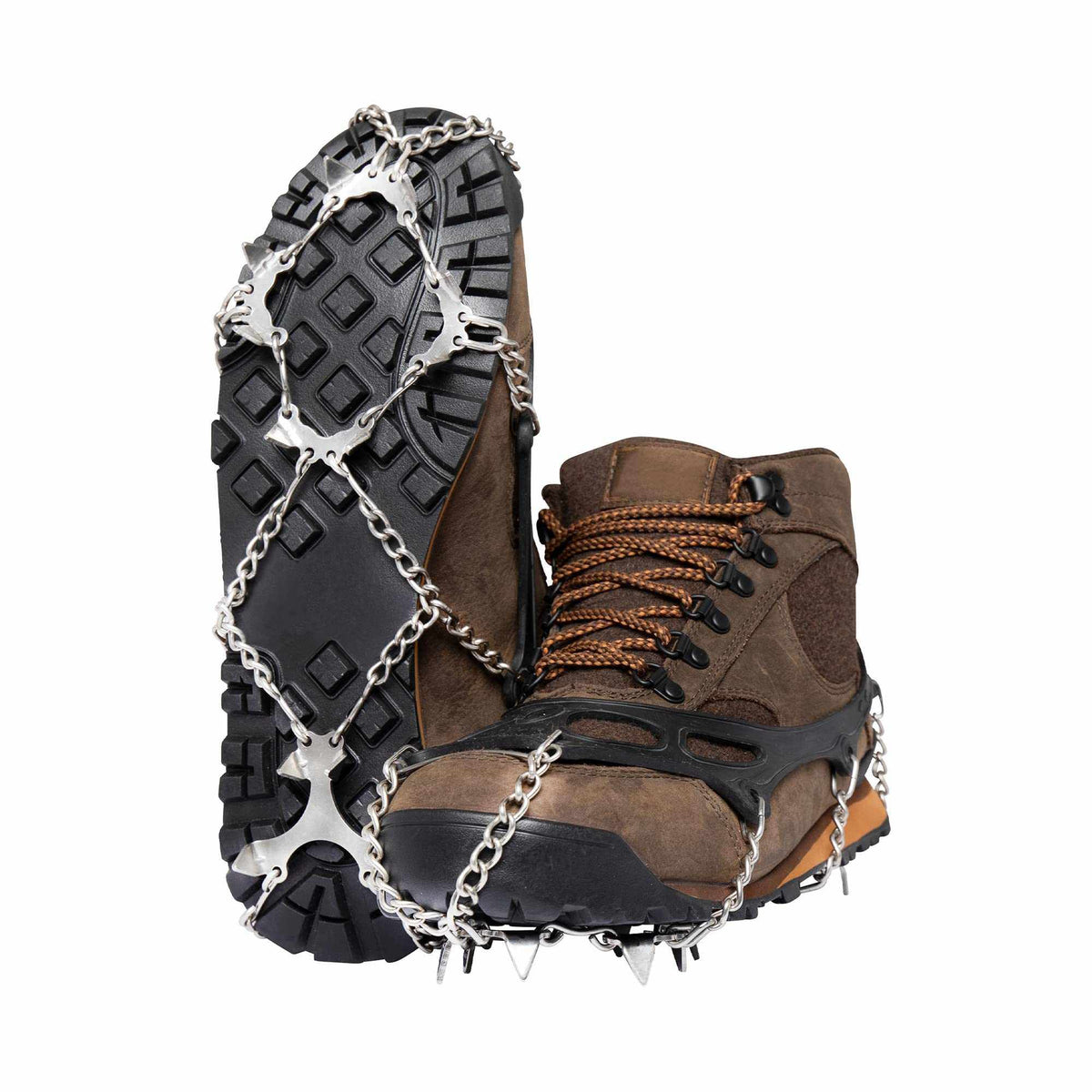
Quick answer: To walk on ice without falling, take short, flat-footed steps with your toes pointed slightly out, keep your weight over your front foot, and keep your hands out of your pockets. This is often called the "penguin walk". The most reliable fix, though, is to stop relying on friction at all: ice spikes or ice cleats bite into the ice, so you aren't depending on your boot sole to grip a surface that's barely solid.
Ice is one of the strangest materials on earth. It's hard enough to drive a truck across a frozen lake, yet a puddle of it in a parking lot can drop you faster than a tackle. And here's the twist: for almost 180 years, some of the world's best scientists couldn't agree on why it's so slippery. Below we'll get into that story, then into the practical part: the six kinds of ice most likely to put you on the ground, how to walk on them, how to fall if you do, and when it's time to strap on spikes.
Why is ice so slippery? A 180-year-old argument
Most of us learned a simple answer in school: your weight melts the ice, and you slide on a thin film of water. It's a neat explanation. It's also mostly wrong.
- 1842, the "wet skin" idea. Michael Faraday noticed that two ice cubes pressed together freeze into one, and that your warm hand sticks to ice. He proposed that ice is always covered by a thin, water-like layer, even below freezing. Scientists now call this "premelting".
- Mid-1800s, the pressure theory. James Thomson suggested pressure from a foot or a skate blade melts the surface. His brother, the famous physicist Lord Kelvin, confirmed that pressure really does lower ice's melting point. The problem? In the 1930s, Cambridge researchers Frank Bowden and T.P. Hughes calculated that a person simply doesn't press hard enough to melt ice that way.
- 1930s, the friction theory. Bowden and Hughes, working in an ice cave high in the Swiss Alps, argued that the heat of sliding melts the surface instead. But ice is slippery before you even start moving, so that can't be the whole story.
- 2018, the "-7 °C" surprise. A team led by Daniel Bonn in Amsterdam and Mischa Bonn in Germany measured friction on ice from –100 °C up to 0 °C. They found loose, rolling water molecules on the surface that behave more like a gas than a liquid layer, and that friction was lowest at around –7 °C. That's the same temperature speed-skating rinks aim for.
- 2025, the newest idea. Researchers at Saarland University in Germany argue that sliding scrambles the crystal structure of the ice surface itself, creating a disordered, slick layer even in deep cold.
The takeaway for anyone walking to the bus stop: ice is slippery at almost every temperature you'll meet in a Canadian winter, and there's no "safe" cold. That's exactly why a rubber boot sole, which depends on friction, struggles, while a steel spike that pierces the surface doesn't.
How many people actually fall on ice?
More than you'd think. According to Toronto's UHN Foundation, more than 21,000 Ontarians visit an emergency room each winter because of slips and falls on ice and snow. CBC reported that between 2011 and 2016, Saskatchewan averaged 43.4 hospitalizations per 100,000 people from falls on ice, the highest of any province.
And your boots may not be helping as much as you think. KITE's WinterLab tests winter footwear on a tilting floor made of real ice, and about two-thirds of the footwear it has tested fails its minimum slip-resistance test. Even a good winter boot is a rubber sole on an icy surface. Add-on spikes change that.
The 6 most dangerous kinds of ice (and how to spot them)
1. Black ice
Black ice isn't actually black. It's a thin, clear glaze that lets the dark pavement show through, so it looks like a wet road or sidewalk. It forms when rain, drizzle or meltwater freezes on a cold surface, often overnight and early in the morning. How to spot it: pavement that looks wet when everything around it is frozen, a glossy shine under streetlights, and patches in shaded spots, on bridges and near downspouts.
2. Wet ice near 0 °C
When the temperature hovers around freezing, ice gets a layer of real meltwater on top. Water on ice is about as slippery as surfaces get, which is why thaw days are often worse than cold snaps.
3. Freeze-thaw ice (hello, chinooks)
If you live in Calgary or southern Alberta, you know the pattern: a chinook pushes temperatures above zero, snow melts across sidewalks, then it all freezes again overnight. The result is lumpy, rutted, glass-hard ice that can last for days. Prairie and Eastern cities get the same thing during January thaws.
4. Ice hiding under fresh snow
A light dusting of snow on top of old ice looks harmless and feels grippy for the first step, right before your foot shoots out. If it snowed on top of a melt, assume there's ice underneath.
5. Polished ice in high-traffic spots
Bus stops, store entrances, crosswalks and the bottom of stairs get packed and polished by hundreds of feet a day. These spots turn into small skating rinks, and they're exactly where most people are rushing, carrying things or looking at their phone.
6. Trail ice
Winter trails get packed into a firm, icy surface by other hikers, and creek crossings, shaded switchbacks and frozen waterfalls (think canyon ice walks in the Rockies) turn into sheets of ice. This is where short city cleats run out of grip and you need longer spikes. Our complete winter traction guide covers which type suits which trail.
How to walk on ice: the penguin walk, step by step
Penguins don't fall over much, and safety experts from hospitals to the U.S. Army use them as the model for walking on ice. Here's how to do it right:
- Bend your knees slightly and lean a little forward, so your weight sits over your front foot rather than behind you.
- Point your toes slightly outward to widen your base of support.
- Take short steps and put your whole foot down flat, instead of striking with your heel.
- Lift your feet slightly. Short steps don't mean dragging: shuffling makes it easy to catch your toe on a ridge of ice and trip.
- Keep your hands free and out of your pockets, so you can balance and catch yourself. Use a backpack instead of carrying bags.
- Slow down and look ahead, not at your phone. Most falls happen when you're rushing.
- Step down, not out, when getting off curbs and out of cars. Hold the door frame and plant both feet before you stand up.
- Walk on snow or grass beside the path when you can. It's usually grippier than packed ice.
How to fall safely on ice
Even with perfect technique, sometimes you go down. If you feel yourself falling:
- Tuck your chin so your back, not your head, hits the ground first.
- Try to relax and roll onto your side, buttocks or thigh rather than landing stiffly.
- Don't throw your arms straight back. Bending your elbows helps protect your wrists, one of the most common winter fractures.
- Get up slowly: roll onto your hands and knees, then stand up using something solid if you can.
If you hit your head, or something hurts more than a bruise, get checked out.
Why ice spikes work when boots don't
Everything above is about managing a low-friction surface. Ice spikes and ice cleats get around the problem: instead of hoping your rubber sole grips the slick top layer, metal spikes or studs press into the ice and anchor each step. It's the same reason hockey players can't walk across a rink in sneakers, but a referee in skate guards with grips can.
Here's how to match traction to the ice you'll actually meet:
| Your winter | What to wear | Why | Price (CAD) |
|---|---|---|---|
| Sidewalks, driveways, bus stops | City Spikes | Light, slip-on cleats for black ice and polished city ice | $26.00 |
| Commuting on mixed pavement and ice | Urban Spikes | Low profile so you walk naturally; carry case for when you're inside | $45.00 |
| Freeze-thaw ruts, trails, dog walks | Ice Spikes | 15 mm stainless steel spikes on chains, harness tested to –40 °C | $65.00 |
| Uneven ground and work sites | Mount Tracks | 13 stainless spikes with a Velcro strap that stays put when you lift or twist | $60.00 |
| Winter running | Trail Spikes | Flexible chain moves with your stride on packed snow and ice | $80.00 |
| Kids walking to school | SureStep Kids | Short 7 mm spikes, only 170–180 g, toddler 9 to kids' 7 | $40.00 |
Outfitting the whole house? The Family Winter Traction Pack ($118) covers two adults and a child, and the Winter Commuter Pack ($55) is built for the daily walk to work. Not sure which is right for you? See our best ice cleats and ice spikes in Canada picks, and our tips on how to fit ice cleats on your shoes.
Three ice spike habits that keep you safe
- Put them on before you need them, sitting down at the door, not halfway across an icy parking lot.
- Take them off indoors. Metal spikes are slippery on tile, marble and smooth concrete floors.
- Keep a pair where you'll actually use them: by the front door, in the car, in your work bag. For older relatives, see our guide to ice cleats for seniors.
Myths about walking on ice
"Colder ice is less slippery." Not really. Lab tests found sliding friction is lowest around –7 °C, and newer research suggests ice stays slick even in deep cold. Very cold ice can feel grippier underfoot than wet ice, but there's no temperature where it becomes safe.
"Good winter boots are enough." Boots keep you warm and dry, but in independent testing about two-thirds of winter footwear failed a basic slip test on ice. Treads that are great in snow can still skate on glare ice.
"Salt fixes everything." Rock salt works much less well in deep cold, roughly below –10 °C, and freshly salted ice is often wet and slick before it melts. Sand or grit improves grip; spikes improve it more.
"Spikes are only for hikers." Most falls on ice happen on everyday errands, in parking lots, on sidewalks and at front steps, not on mountain trails. A light pair of city cleats is arguably more useful than hiking spikes for most people.
Frequently asked questions
What is the best way to walk on ice?
Use the penguin walk: bend your knees slightly, point your toes out, take short flat-footed steps with your weight over your front foot, and keep your hands free. For real grip, add ice cleats or ice spikes.
Why is ice so slippery?
The surface of ice has a thin, disordered layer of loosely bound water molecules that acts like a lubricant. Scientists still debate exactly how it forms, but it's present across the whole range of winter temperatures, and lab studies found ice friction is lowest around –7 °C.
How can you tell if there's black ice?
Look for pavement that looks wet or glossy when the air is below freezing, especially in shaded areas, on bridges and overpasses, near downspouts, and early in the morning. If in doubt, assume it's ice.
Do ice cleats work on black ice?
Yes. Black ice is exactly what ice cleats are designed for. The metal studs or spikes press into the thin glaze, giving grip that a rubber sole can't. For thin city ice, light cleats like City Spikes work well.
What temperature is ice most slippery?
Wet ice right around 0 °C, with meltwater on top, is often the most treacherous underfoot. In lab sliding tests, friction on dry ice was lowest around –7 °C. Either way, ice is slippery across the whole winter range.
Can you wear ice spikes indoors?
No. Take them off before going inside. Metal spikes can scratch floors and are slippery on smooth surfaces like tile and polished concrete.
Sources: Quanta Magazine; Phys.org, "The slipperiness of ice explained" (2018); UHN Foundation; KITE Rate My Treads; CBC News; Nova Scotia Health.
Stay on your feet this winter
Ice has been confusing physicists since Faraday, but you don't need to solve it to stay upright. Walk like a penguin, watch for the six danger zones, and let steel do the gripping. Browse all our ice spikes and ice cleats, shipped across Canada with free shipping on orders over $100.

Leave a comment
All comments are moderated before being published.
This site is protected by hCaptcha and the hCaptcha Privacy Policy and Terms of Service apply.