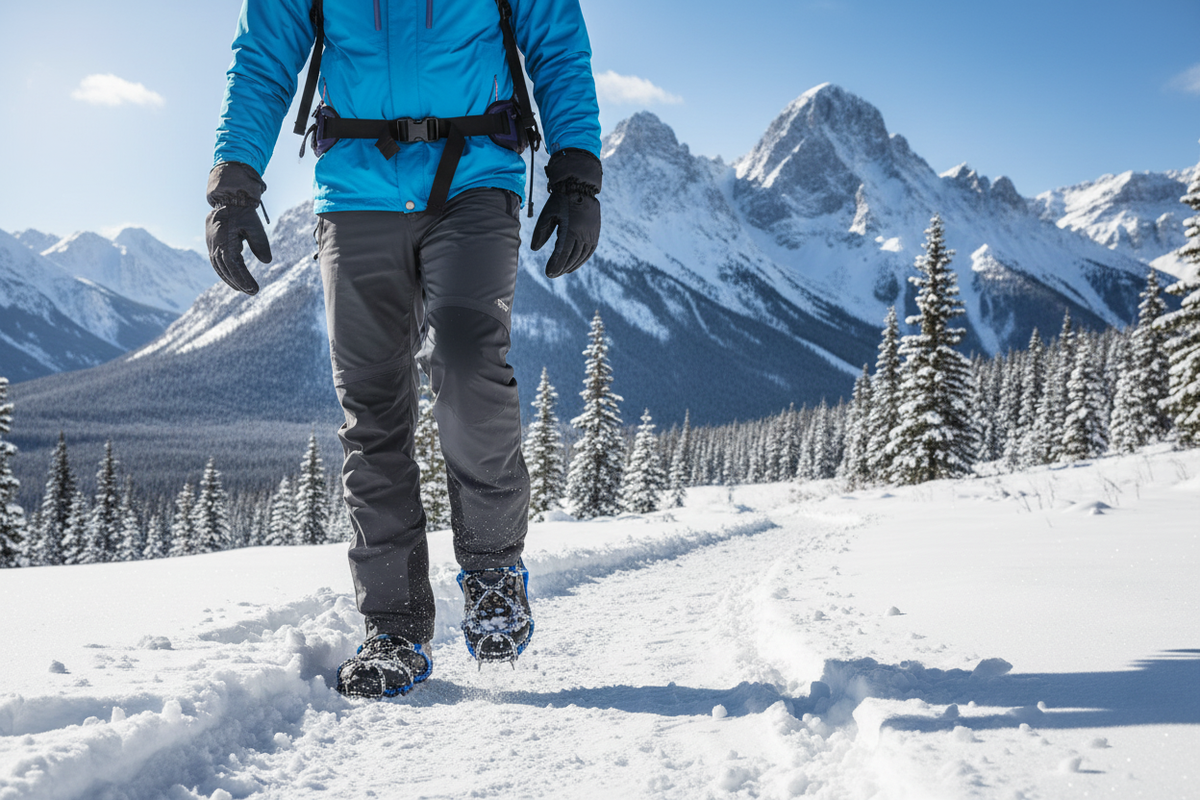
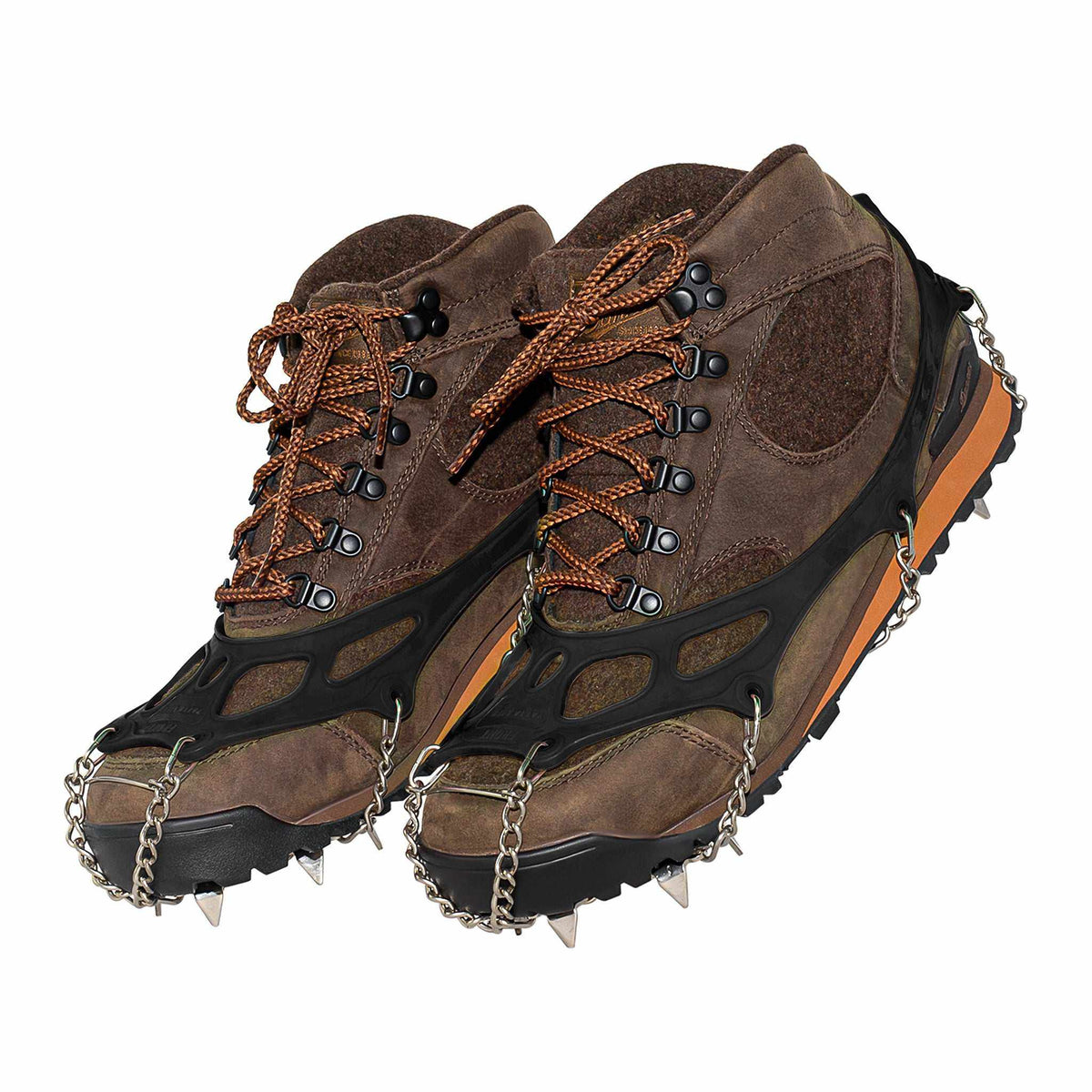
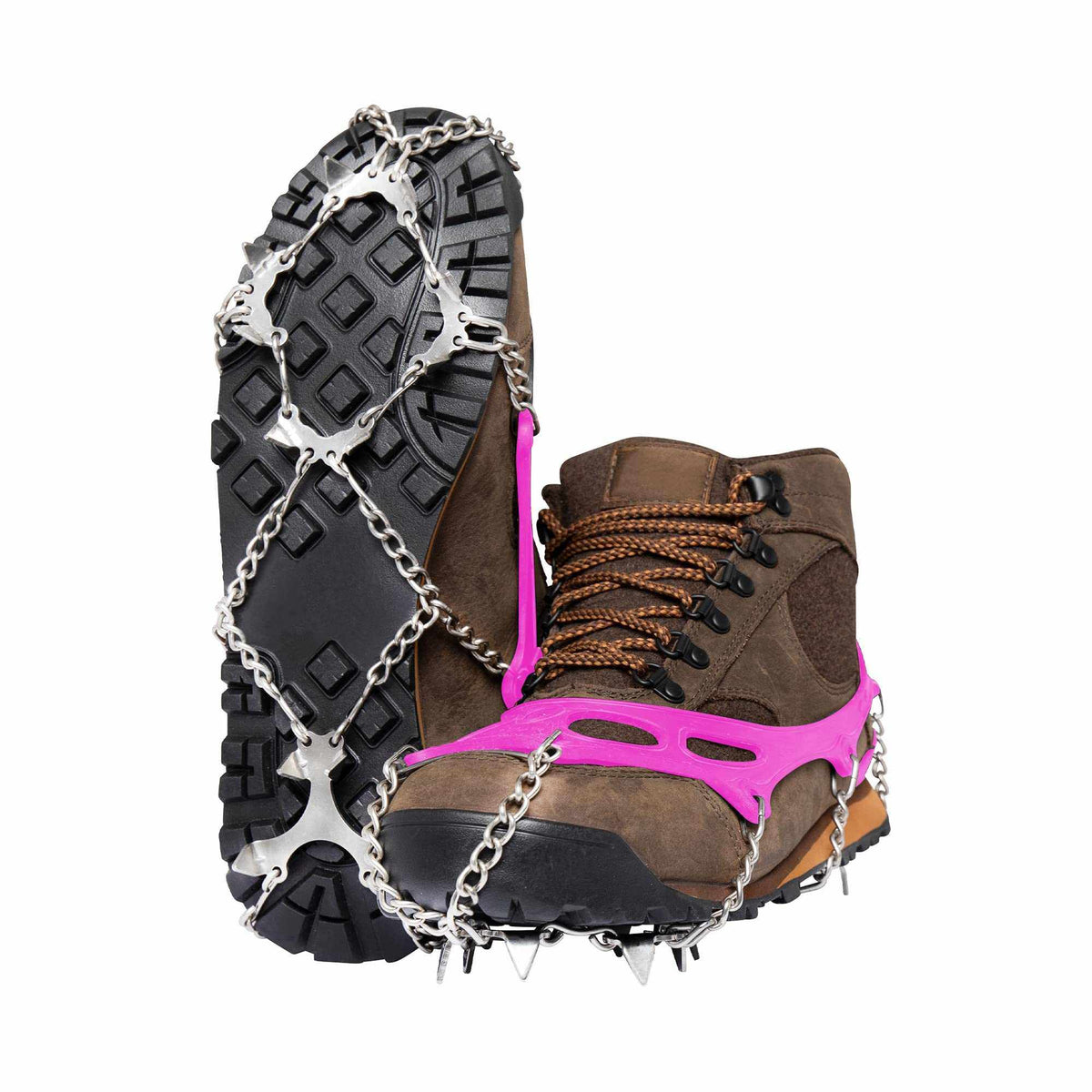
Quick answer: Yes. Parks Canada says the Johnston Canyon trail is "usually very icy" in winter and strongly recommends ice cleats. The same goes for most popular winter walks around Banff, Canmore, Lake Louise and Kananaskis. Pack a pair of Ice Spikes ($65) with 15 mm stainless steel spikes, or the Winter Hiker Kit ($162), which adds boot gaiters and waterproof socks. One important note for this season: Parks Canada closed the main Johnston Canyon trail on October 13, 2026 for rock slope repairs, and Maligne Canyon in Jasper is still closed after the 2024 wildfire. Check current conditions before you go.
Winter in the Rockies does something strange to a trail. Thousands of boots pack the snow flat. A sunny afternoon softens the top layer. The night refreezes it. After a few weeks of that, a gentle walk to a waterfall becomes a long, narrow skating rink, often with a railing on one side and a creek on the other.
That's why "do I need ice cleats?" is one of the most common questions we hear from people heading to Banff or Jasper. We're a Calgary company, and these are the trails we walk ourselves. Below are six popular winter walks, what they're like on the ground, what's open right now, and what we'd put on our boots.
Canyon trails add one more problem: water. Spray and seepage freeze onto walkways, steps and railings. Rubber boot soles have little to grip on polished ice. Steel spikes push into it instead. For the full story, read our guide on how to walk on ice.
1. Johnston Canyon (Banff National Park)
What it's like in winter: Johnston Canyon is the classic Banff icewalk. Parks Canada describes it as wide trails and narrow bridges with railings deep in the canyon. The catwalks are bolted to the canyon walls above Johnston Creek, and in winter the waterfalls freeze into columns of blue and white ice. Parks Canada lists the Lower Falls at 1.2 km one way (about 50 m of elevation gain) and the Upper Falls at 2.5 km one way (about 120 m gain).
Typical conditions: Packed, polished ice on the trail and catwalks, with icy stairs and slopes on the way to the Upper Falls. Parks Canada's own words: "The trail is usually very icy – ice cleats are strongly recommended."
Open this winter? Check current conditions. Beginning October 13, 2026, Parks Canada closed the Johnston Canyon trail from the parking lot to both the Lower and Upper Falls viewpoints, along with the main (P1) parking lot and washrooms, for rock slope remediation work. News reports put the planned end date at around December 11, 2026, and say more work is planned for fall 2027. During the closure, Parks Canada says the Upper Falls and Ink Pots stay reachable from the Moose Meadows trailhead, which is a longer walk with limited parking. Roam Transit's Route 9 to Johnston Canyon is also paused during the closure.
Do you need traction? Yes. This is the trail where we see the most people sliding along the railings in running shoes.
Our pick: Ice Spikes ($65). The 15 mm spikes on welded chains bite into polished catwalk ice and grip on stairs. If you're coming from out of town and want everything in one box, the Winter Hiker Kit ($162) is the easy choice.
Practical tips:
- Check the Parks Canada Banff bulletins for the reopening date before you drive out.
- Stay on the trail. Parks Canada has a restricted activity order that prohibits off-trail use at Johnston Canyon.
- Go early in the day. It's one of the busiest winter walks in the park, and the trail is narrow in places.
- Several Banff tour companies run guided Johnston Canyon icewalks when the trail is open. Some include traction. Ask when you book.
2. Maligne Canyon icewalk (Jasper National Park)
What it's like in winter: In a normal winter, the Maligne Canyon icewalk is something special. Guides lead groups down onto the frozen canyon floor, between walls of ice, past frozen waterfalls.
Typical conditions: Parks Canada lists the hazards plainly: slippery, uneven surfaces, thin or breakable shelf ice, cold fast-moving water below the ice, falling rock and ice, and limited exits. On the trail along the rim, the snow can be icy and the edge sits close to the canyon drop.
Open this winter? Check current conditions. Parks Canada and Tourism Jasper both say Maligne Canyon remains closed after damage from the 2024 Jasper Wildfire Complex. Parks Canada's Maligne Canyon winter page says it "will remain closed for the 2026 season." Tourism Jasper lists guided icewalks in nearby Pleckaitis Canyon as an alternative, offered by local operators. Call Tourism Jasper at 780-852-6236 for the latest.
Do you need traction? Yes, wherever you walk. Parks Canada says a helmet and ice cleats are "highly recommended" in the canyon, and that the safest way to visit is with a guide. Guided tours often supply boots and cleats, so ask before you book.
Our pick: If you're joining a guided tour that supplies gear, you may not need your own spikes for the canyon itself. For icy Jasper town sidewalks and other trails on the same trip, Ice Spikes ($65) or Mount Tracks ($60), with 13 stainless spikes and a Velcro strap, are both good choices.
Practical tip: Don't try a canyon-floor icewalk on your own unless you know how to judge ice. Shelf ice can look solid over moving water. Cell coverage in the canyon is unreliable.
3. Grassi Lakes (Canmore)
What it's like in winter: Grassi Lakes is a short climb above Canmore to two small, clear lakes. In winter there are two routes, and only one is open. Alberta Parks closes the steeper Interpretive route in winter because water flows over the trail and freezes. The easier Upper route, a wider path, stays open. Alberta Parks lists it at 1.9 km with about 125 m of elevation.
Typical conditions: Alberta Parks says "the trail may be icy any time during the colder months" because of snow compaction and freeze-thaw. Expect hard-packed, polished ice on the uphill sections and the walk back down.
Do you need traction? Yes. Alberta Parks recommends proper footwear, micro spikes and poles. Coming downhill on polished ice is where most slips happen.
Our pick: Ice Spikes ($65) or Trail Spikes ($80). Add hiking poles if you have them.
Practical tips:
- You need a Kananaskis Conservation Pass to park in Kananaskis and the Bow Valley. This is a provincial pass, separate from a Parks Canada pass.
- Don't take the closed Interpretive route, even if you see footprints on it.
- Check the Alberta Parks trail report for Grassi Lakes before you go.
4. Lake Louise Lakeshore (Banff National Park)
What it's like in winter: The Lakeshore trail starts in front of the Chateau Lake Louise and follows the north shore toward the back of the lake. Parks Canada lists it as an easy walk, 2.3 km one way, ending near a frozen waterfall about 100 m tall. Dogs on leash are allowed.
Typical conditions: Parks Canada's trail report in late October 2026 listed it as "snow covered with icy sections" with a caution for slippery sections. Busy stretches near the Chateau get packed hard.
Do you need traction? We'd bring it. The trail is mostly flat, but packed snow near a busy hotel turns to polished ice fast, and the walk back is just as slick as the walk out.
Our pick: Ice Spikes ($65) for the trail. If your group includes kids, the Family Winter Traction Pack ($118) covers adults and children.
Practical tips:
- Avalanche warning: Parks Canada says the trail beyond the end of the lake leads to dangerous avalanche terrain, and travel beyond that point requires avalanche training and equipment. Turn around at the end of the lake.
- The frozen waterfall at the back of the lake is a popular ice-climbing spot. Parks Canada warns falling ice can be a hazard, so don't stand directly beneath it.
- Parks Canada's paid parking at the Lakeshore lot applies during the summer shuttle season (May 15 to October 12 in 2026). Check current parking rules before you go.
- Want a longer walk? Parks Canada calls the 2.9 km Louise Creek trail "the best pedestrian option from the village to the lake."
5. Troll Falls (Kananaskis)
What it's like in winter: Troll Falls is a short, mostly flat walk through the forest near Kananaskis Village to a waterfall that freezes into a wall of ice. It's a favourite for families and anyone wanting an easy winter outing an hour or so from Calgary.
Typical conditions: Alberta Parks warns that "the trail may be icy any time during the colder months, even when other areas and trails are not." Near the falls, the ground is often glazed from spray and foot traffic.
Do you need traction? Yes. Alberta Parks says to "always come prepared with proper footwear, micro spikes, and poles."
Our pick: Ice Spikes ($65) for adults. For kids, SureStep Kids ice cleats ($40) fit sizes from toddler 9 to kids' 7.
Practical tips:
- A Kananaskis Conservation Pass is required to park.
- Alberta Parks has blocked off random trails around the main waterfall, including the climb up to the Troll, because of extreme rockfall hazards. Stay on the maintained trail.
6. Sundance Canyon (Banff National Park)
What it's like in winter: From the town of Banff, you follow the Sundance trail, then do a loop through a small, rocky canyon. Parks Canada lists it as moderate: 3.7 km one way plus a 2.1 km loop, with about 155 m of elevation gain. It's quieter than Johnston Canyon and close to town, which makes it a good option while Johnston is closed.
Typical conditions: Parks Canada says "this trail can be icy – ice cleats are strongly recommended." In early November 2026, its trail report listed icy sections, thin snow cover and wet, muddy patches.
Do you need traction? Yes, especially on the canyon loop, which has steeper, rockier sections.
Our pick: Trail Spikes ($80) or Ice Spikes ($65).
Practical tip: Bikes aren't allowed past the bike racks at the canyon, so if you ride the first part, plan to walk the loop.
Also icy: Tunnel Mountain summit, which Parks Canada says "can be extremely icy." For more ideas, see The Best Alberta Winter Hikes for Using Ice Spikes and 9 of the Best Winter Hikes in Canada.
Quick chooser: which traction for which trail
| Trail | Typical winter surface | Traction needed? | Our pick |
|---|---|---|---|
| Johnston Canyon | Polished ice on catwalks and stairs | Yes | Ice Spikes $65 |
| Maligne / Pleckaitis Canyon (guided) | Canyon-floor ice, uneven | Yes (tours often supply gear) | Ask your guide; Ice Spikes for the rest of your trip |
| Grassi Lakes (Upper) | Packed, icy uphill and downhill | Yes | Trail Spikes $80 |
| Lake Louise Lakeshore | Packed snow with icy sections | Recommended | Ice Spikes $65 |
| Troll Falls | Icy, glazed near the falls | Yes | Family Pack $118 |
| Sundance Canyon | Icy sections, rocky loop | Yes | Trail Spikes $80 |
What about City Spikes? Our City Spikes ($26) are great for sidewalks and parking lots in Banff, Canmore or Jasper. They're not our pick for canyon trails, stairs or hills, where you want longer spikes across the whole sole.
What to wear for a Rockies icewalk
Canyons are colder than the parking lot. They're shaded, close to water and often breezy. Dress for standing still at a frozen waterfall, not just for walking.
- Layers: a non-cotton base layer, a warm mid layer and a windproof shell.
- Boots: insulated, waterproof boots that your spikes fit over. Our fitting guide shows how.
- Gaiters: keep snow out of your boots on deeper sections.
- Waterproof socks: canyon trails can have slush and seepage, even in deep cold. Dry feet are warm feet.
- Extras: a toque, gloves you can grip a railing with, poles, water and a headlamp. Winter days are short.
The Winter Hiker Kit ($162) puts the footwear part together in one order: Ice Spikes, Cordura boot gaiters and waterproof socks.
How to get your spikes before your trip
- Order online before you leave. We ship across Canada from Calgary, so you can have spikes at home before your drive or flight.
- Free shipping over $100. The Winter Hiker Kit or Family Winter Traction Pack gets you there on its own.
- 14-day returns if the size or style isn't right.
- Try them on at home. Put them on over the boots you'll actually wear and walk around your driveway. It's much easier than fitting them for the first time at a cold trailhead.
Not sure which style suits you? Our winter traction guide compares them, or browse all our ice cleats and spikes.
Staying safe on winter canyon trails
- Check conditions first. Trails, parking lots and canyons close for construction, ice and wildfire recovery. Use the Parks Canada trail conditions page for Banff, Parks Canada pages for Jasper, and Alberta Parks trail reports for Kananaskis and Canmore.
- Check the avalanche forecast. Parks Canada says avalanche season in the mountains runs from November to June, and that when you travel beyond marked trails or past an avalanche danger sign, you should assume you're in avalanche country. Check avalanche.ca before any mountain outing. Don't assume any trail is free of avalanche risk.
- Stay on the trail. Shortcuts around railings, onto creek ice or up to frozen waterfalls are where serious accidents happen. Some areas, like Johnston Canyon, prohibit off-trail travel.
- Treat ice over water as unsafe, and don't stand under frozen waterfalls, ice climbers or canyon walls.
- Spikes aren't crampons. Ice Spikes are made for icy trails, with a harness tested to –40 °C. They're not for technical mountaineering, glaciers or vertical ice.
- Plan for no signal. Parks Canada notes cell coverage isn't reliable throughout the parks. Tell someone your plans. In an emergency, call 911.
- Bring the right pass. You need a Parks Canada pass (daily or annual Discovery Pass) to stop in Banff or Jasper, and a Kananaskis Conservation Pass to park at Grassi Lakes or Troll Falls.
FAQ
Do I need ice cleats for Johnston Canyon?
Yes. Parks Canada says the Johnston Canyon trail is usually very icy in winter and strongly recommends ice cleats. The catwalks, stairs and slopes polish into hard ice. A pair of spikes with steel points across the whole sole, like Yatta Life Ice Spikes, is the right tool.
Is Johnston Canyon open in winter 2026?
Not fully, at time of writing. Parks Canada closed the trail to the Lower and Upper Falls, plus the main parking lot and washrooms, starting October 13, 2026 for rock slope repairs. Reports put the planned end date at around December 11, 2026. The Upper Falls and Ink Pots stay reachable from the Moose Meadows trailhead. Check Parks Canada bulletins for current conditions.
Is the Maligne Canyon icewalk running this winter?
Parks Canada and Tourism Jasper say Maligne Canyon remains closed after the 2024 wildfire. Some Jasper tour companies offer guided icewalks in nearby Pleckaitis Canyon instead. Contact Tourism Jasper for current conditions.
What should I wear for a Banff canyon icewalk?
Wear insulated waterproof boots with ice spikes, non-cotton layers with a windproof shell, a toque and gloves. Gaiters and waterproof socks keep your feet dry on slushy or snowy sections. Canyons are shaded and cold, so bring an extra warm layer for standing at the falls.
Are ice spikes the same as crampons?
No. Ice spikes, sometimes called microspikes, use short steel spikes on chains under a stretchy harness. They're made for icy trails, walkways and packed snow. Crampons have longer front points and are made for mountaineering and steep ice. Don't use ice spikes to climb frozen waterfalls or travel on glaciers.
Do I need ice cleats for Grassi Lakes in winter?
Yes. Alberta Parks says the trail may be icy any time during the colder months and recommends micro spikes and poles. Only the easier Upper route is open in winter. The Interpretive route is closed because water flows over it and freezes.
The Rockies in winter are worth the trip. Frozen waterfalls, quiet trails and blue canyon ice are hard to beat. The trails just ask for a little more than running shoes. Get your Ice Spikes or Winter Hiker Kit before you go, check current conditions on the morning of your walk, and enjoy it.
Sources: Parks Canada, Winter walking trails in the Banff area; Parks Canada, Banff trail conditions; Parks Canada, Banff important bulletins; Parks Canada, Lake Louise winter trails; Parks Canada, Lake Louise parking FAQ; Parks Canada, Banff fees; Parks Canada, Winter in Maligne Canyon; Tourism Jasper, Maligne Canyon icewalk; Alberta Parks, Grassi Lakes Upper trail report; Alberta Parks, Troll Falls trail report; Travel Banff Canada, Johnston Canyon closure dates; Avalanche Canada. Trail conditions and closures change often. Check current conditions before you go.

Leave a comment
All comments are moderated before being published.
This site is protected by hCaptcha and the hCaptcha Privacy Policy and Terms of Service apply.