
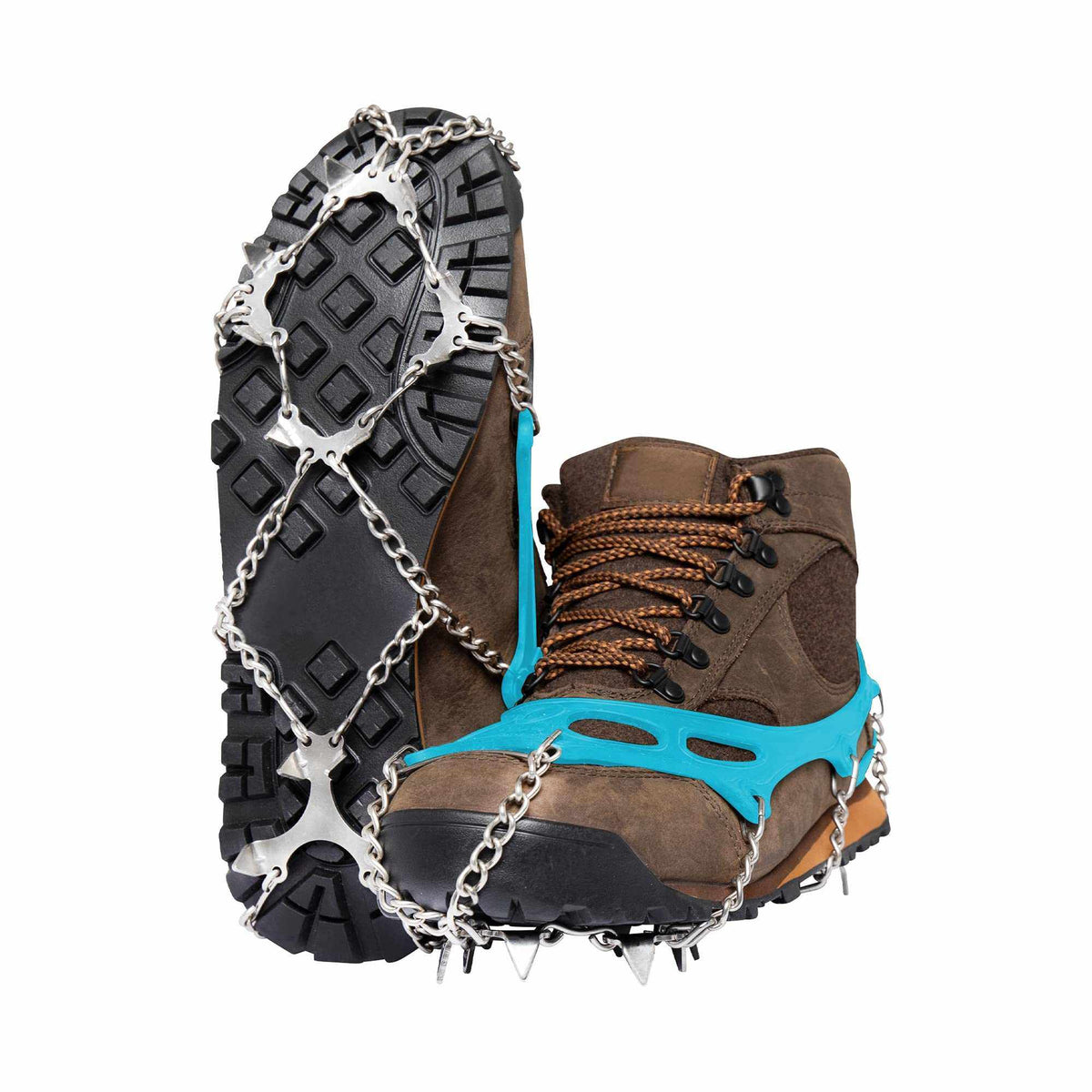
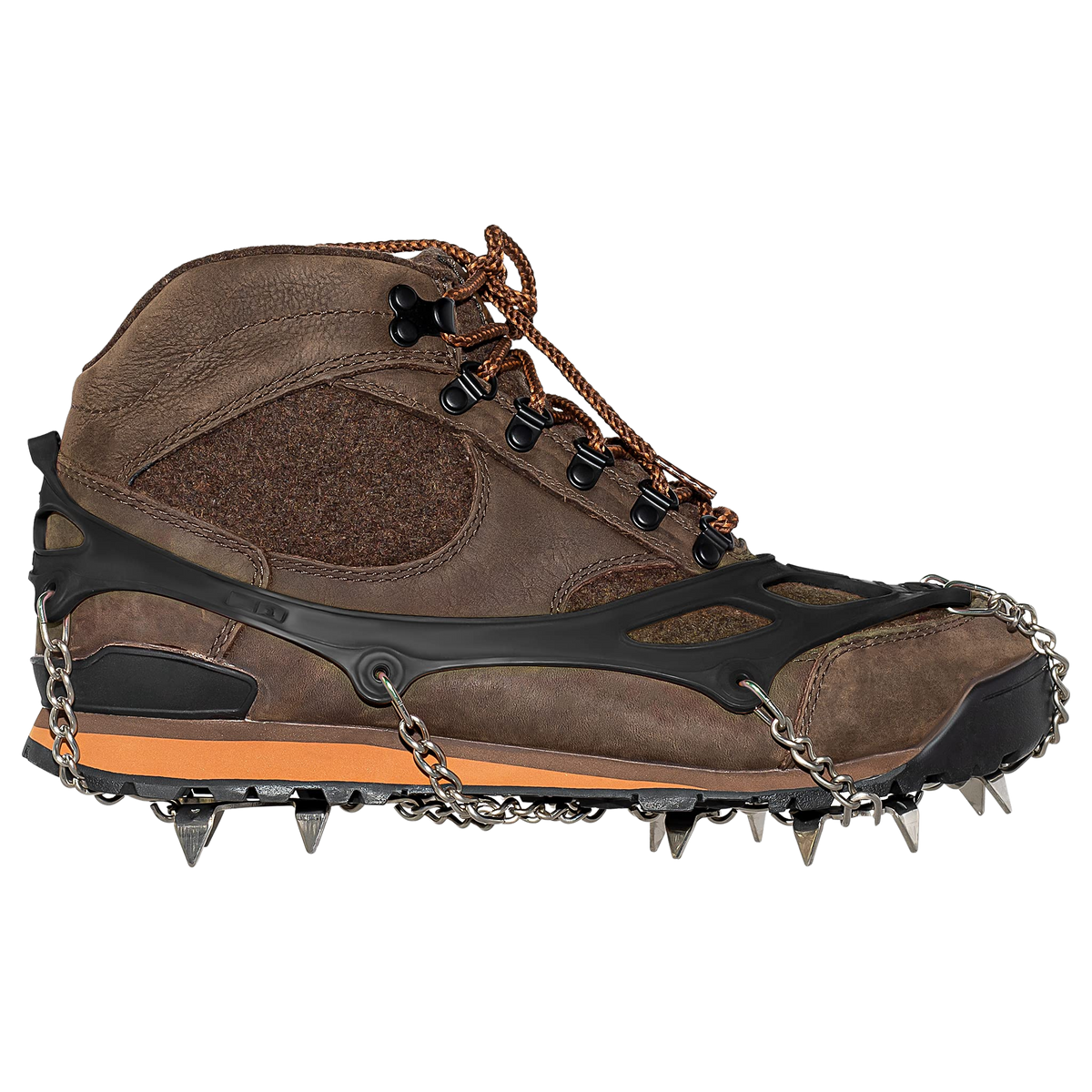
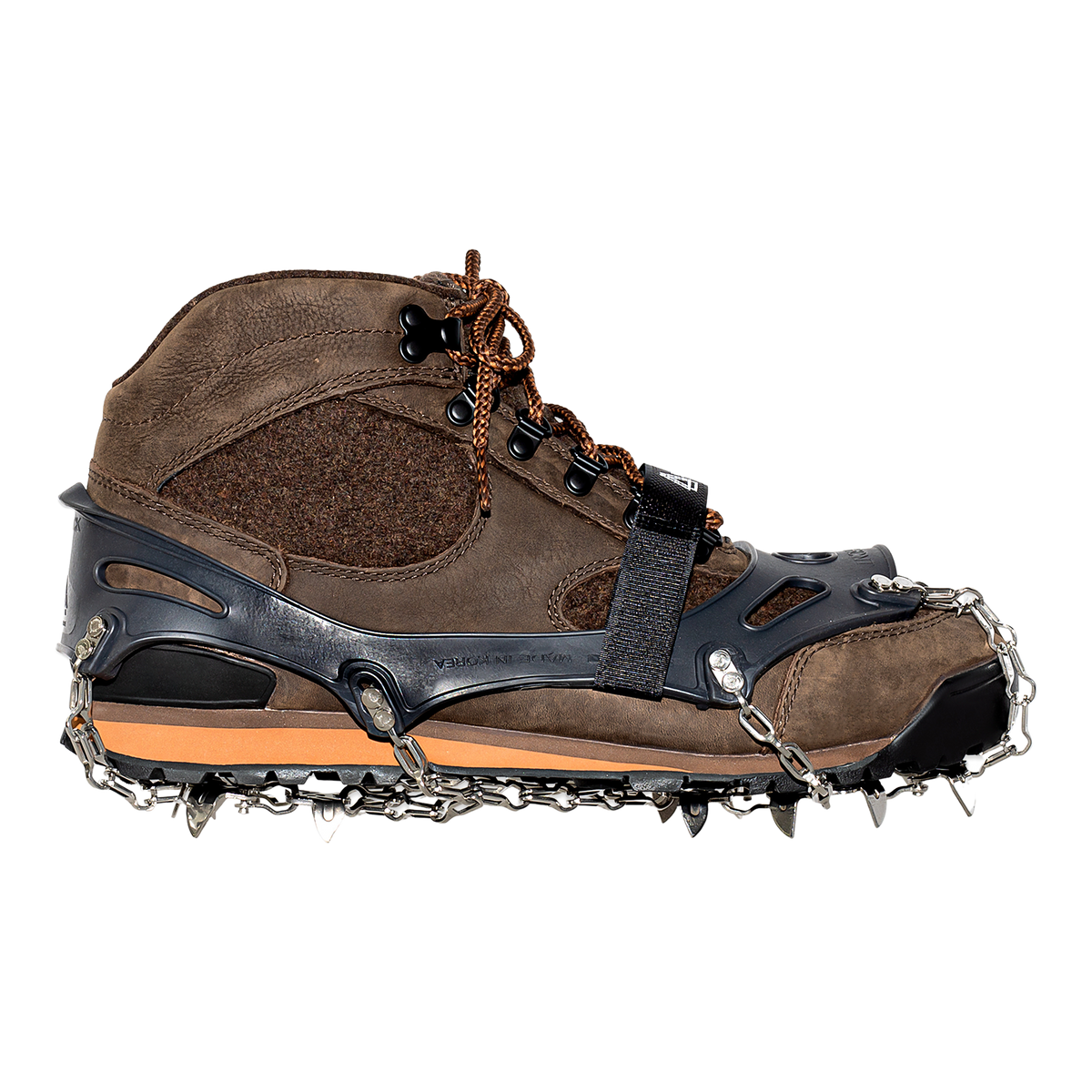
Quick answer: The best ice fishing cleats are full-sole stainless steel spikes on chains, about 15 mm long, sized to fit over your insulated boots. They bite into bare, wind-polished lake ice and keep gripping around wet auger holes, where short city cleats and rubber soles give up. Our Ice Spikes ($65) and Mount Tracks ($60) are built for this. Cleats keep you upright. They do nothing to make thin ice safe, so check thickness first.
Most anglers who fall on the ice don't fall through it. They slip on it. They're hauling a sled, carrying an auger or stepping around a fresh hole, and their feet go out from under them. A bruised hip is the lucky outcome. A cracked wrist, a smashed rod tip or a knock on the head miles from the truck is not.
This guide covers why lake ice is so much slicker than a sidewalk, what kind of traction works on it, how to size cleats over bulky boots, and the ice safety basics the Canadian Red Cross and the Lifesaving Society recommend.
Why bare lake ice is so slippery
Ice on a lake isn't like ice on your driveway. It's bigger, flatter and more exposed, and that changes how it behaves underfoot.
Wind polishes it smooth
On a big open lake, wind blows the snow off and keeps blowing. Over days and weeks it sands the surface into a sheet of glare ice, smooth enough to see through in places. There are no ruts, no grit and no packed snow to give your boots something to hold.
Auger water and slush
Every hole you drill throws water and ice chips onto the surface around it. That water sits on top of cold ice and turns it into the slickest spot on the lake: wet ice. Within minutes it can freeze into a thin glaze, and the next angler walks onto it. The area around a hole is also where you're bending, twisting, kneeling and lifting fish, so it's exactly where you want the most grip.
Early and late season
Early in the season, new ice is often clear, hard and bare, before any snow has fallen on it. Late in the season, meltwater pools on top during the day and refreezes at night. Both conditions are hard on rubber soles.
If you want the science of why ice is slippery at all, our guide on how to walk on ice covers it. The short version: a rubber sole depends on friction, and ice has very little of it. A steel spike doesn't depend on friction. It pierces the surface and anchors.
What kind of cleats work for ice fishing?
There are three broad kinds of traction you'll see sold as ice cleats. They don't all suit a frozen lake.
| Type | How it grips | On lake ice |
|---|---|---|
| Coil or short-stud cleats | Wire coils or small studs under the sole | Fine on flat sidewalks. On polished lake ice and wet auger water, short studs have less to dig in with. |
| Full-sole chain spikes | Stainless spikes (around 10 to 15 mm) on chains under the whole foot | The usual choice for anglers. Spikes under the toe and heel grip as you step, push and pivot. |
| Strap-on spikes | Spikes on a plate or chain, with a strap over the top of the foot | Good when you're lifting, twisting or hauling a loaded sled, because the strap stops the spikes from rolling off. |
For most people on a lake, full-sole chain spikes are the right call. Here's what to look for.
Spikes under the whole foot
You push off your toes when pulling a sled and land on your heels when you step around a hole. A cleat with spikes only in the middle leaves both ends of your boot on bare ice. Look for spikes under the forefoot and the heel.
Stainless steel
Ice fishing is wet. Your cleats will sit in auger water, get kicked through slush and ride home in a damp bin. Plain steel can rust over a season. Stainless steel resists rust much better, which matters for gear that's wet most of the time. It's still smart to rinse and dry them when you get home, especially if you've been on salted parking lots on the way in.
A harness that stays stretchy in the cold
The rubber harness is the part that fails first in deep cold. Cheap ones stiffen and crack. Our Ice Spikes use a TPR harness tested to –40 °C, which covers a cold morning on most Canadian lakes.
Our picks for ice fishing
Ice Spikes: the all-round lake cleat
Yatta Life Ice Spikes have 15 mm stainless steel spikes on welded stainless chains, with a harness tested to –40 °C. A pair weighs about 300 to 340 g, so you won't notice them on a long walk out to your spot. They stretch over winter boots in a few seconds, and they come in black, blue and pink, which makes it easier to find them when you drop one in the snow. $65.
Mount Tracks: for hauling and heavy lifting
Mount Tracks have 13 stainless steel spikes (15 mm) and add a Velcro strap over the top of your foot. If you're dragging a loaded sled, carrying a shelter or setting up a hut, that strap keeps the spikes centred under your boot when you twist and lean. $60.
Fishing with a partner or the kids? The Family Winter Traction Pack ($118) covers two adults and a child, and orders over $100 ship free across Canada. You can compare every model in our winter traction collection.
How to size cleats over ice fishing boots
This is where most people go wrong. Ice fishing boots are big. Insulated pac boots and heavy rubber boots with liners can be a size or two larger on the outside than your shoe size. Cleats fit the outside of the boot, not your foot.
- Size to the boot you'll actually wear, not your sneakers. If you're between sizes, go up.
- Try them on at home first. Stretching a cold harness over a big boot on the ice with numb fingers is no fun.
- Check the toe and heel. The harness should cup both firmly. If the heel loop sits halfway up the back of the boot, the cleat is too small and will pop off.
- Watch for chains drifting sideways. If the spikes slide toward the outside of your sole as you walk, the fit is loose. Size down, or choose a strapped model like Mount Tracks.
For step-by-step photos, see how to fit ice cleats on your shoes. Not sure about size? Yatta Life has 14-day returns, so you can try a pair on your boots at home.
Moving gear on the ice
Good traction changes how you can move gear, but a few habits help too.
- Pull, don't carry. A sled keeps your hands free and your weight centred. Carrying an auger in one arm and a bucket in the other puts your balance off to one side.
- Lean into the pull and take short steps. Spikes grip best when you put your foot down firmly.
- Carry the auger with the blade guard on. If you do fall, you don't want an exposed blade nearby.
- Kick slush away from the hole and step on dry ice or snow where you can.
- Take cleats off before you step into a heated shack with a wood or plastic floor, if the floor is smooth. Spikes can slip on smooth hard surfaces and scratch them.
Ice safety basics for Canadian anglers
Cleats help you stay on top of the ice. They do nothing about what's under it. Before you walk out, check the ice. Here's what Canadian safety groups recommend.
Minimum ice thickness
The Canadian Red Cross says ice thickness should be a minimum of:
- 15 cm for skating, walking or skiing in small groups
- 20 cm for larger groups, such as skating parties
- 25 cm for snowmobiles or ATVs
The Lifesaving Society's BC and Yukon branch gives the same numbers: 15 cm for walking or skating alone, 20 cm for skating parties or games and 25 cm for snowmobiles. Cars and trucks need much more. If you plan to drive onto a lake, check with local authorities first.
Read the colour of the ice
According to the Lifesaving Society, "clear blue ice is strongest," "white opaque or snow ice is half as strong as blue ice," and "grey ice is unsafe," because the grey colour means water is present. The Red Cross also says to avoid ice that has frozen, thawed and frozen again.
Measure, and keep measuring
The Red Cross recommends going with another person to measure, drilling a hole and measuring the ice along the inside of it, and re-checking every few metres, because thickness varies across a lake. Watch for pressure ridges, air holes, rising mist (a sign of open water), and thinner ice near dark objects that stick out of it. Snow cover can insulate the ice and keep it from freezing solid.
Tell someone, and carry rescue gear
The Red Cross advises checking with local authorities before heading out, avoiding the ice at night, and telling someone where you're going and when you'll be back. It also recommends a flotation device, carrying a pole or long branch to support yourself if you go through, and carrying a throwing or reaching device. Many anglers also wear a pair of ice picks around their neck for pulling themselves out.
The stakes are real. In its ice safety tip sheet, the Red Cross lists the activities behind drowning and cold-water deaths in Canada. Snowmobiling accounts for 55%. Walking, hiking, fishing, hunting and skating together account for 34%.
Frequently asked questions
Do I need cleats for ice fishing?
If the ice is bare, wind-polished or wet around the holes, yes. That's the most slippery surface most people walk on all winter. On deep, fresh snow you may not need them, but conditions change fast once holes get drilled and snow blows off.
What are the best ice cleats for ice fishing?
Full-sole stainless steel chain spikes, around 15 mm long, with a harness that stays flexible in deep cold. Yatta Life Ice Spikes are our all-round pick. Mount Tracks add a top strap for hauling and lifting.
Should I size up ice cleats for ice fishing boots?
Size cleats to the boot you'll wear, not your shoe size. Insulated pac boots are often a size or two bigger on the outside. If you fall between sizes, go up.
Will stainless steel ice spikes rust?
Stainless steel resists rust much better than plain steel, which is why it suits wet ice fishing conditions. Rinse and dry your spikes after a trip, especially if you've walked through road salt.
How thick does ice need to be to walk on?
The Canadian Red Cross recommends a minimum of 15 cm for walking, skating or skiing in small groups, 20 cm for larger groups and 25 cm for snowmobiles or ATVs. Clear blue ice is strongest. White opaque ice is about half as strong, and grey ice is unsafe.
Do ice cleats make thin ice safer?
No. Cleats only stop you from slipping. They don't spread your weight or make ice stronger. Always check thickness and colour before walking out.
Sources: Canadian Red Cross, "Safety On and Around the Ice"; Canadian Red Cross, "Is that ice safe?"; Lifesaving Society BC & Yukon, "Ice Safety".
Get out there, and get home
A good day on the ice ends with fish in the bucket and nobody limping back to the truck. Check the ice, tell someone your plan, and put steel under your boots. Shop Ice Spikes, Mount Tracks or the full winter traction collection, with free shipping across Canada on orders over $100. For more on picking the right pair, see our complete winter traction guide.

Leave a comment
All comments are moderated before being published.
This site is protected by hCaptcha and the hCaptcha Privacy Policy and Terms of Service apply.