
Quick answer: Ice cleats are worth it if you regularly walk on ice you can't avoid: icy sidewalks, unplowed paths, parking lots, trails or frozen lakes. They work by pressing metal into the ice instead of relying on rubber, and testing and at least one randomized trial suggest they reduce slips. They're probably not worth it if you rarely see ice, drive door to door, or won't put up with taking them on and off. The downsides are real: you have to remove them indoors, they're slippery on tile, and they wear on bare pavement.
We should say this up front. We're Yatta Life, a Calgary company, and we sell ice cleats. So we have an obvious reason to tell you everyone needs a pair. We don't think that's true, and we'd rather you buy something that ends up on your boots than in a drawer. Here's our honest take.
Do ice cleats actually work?
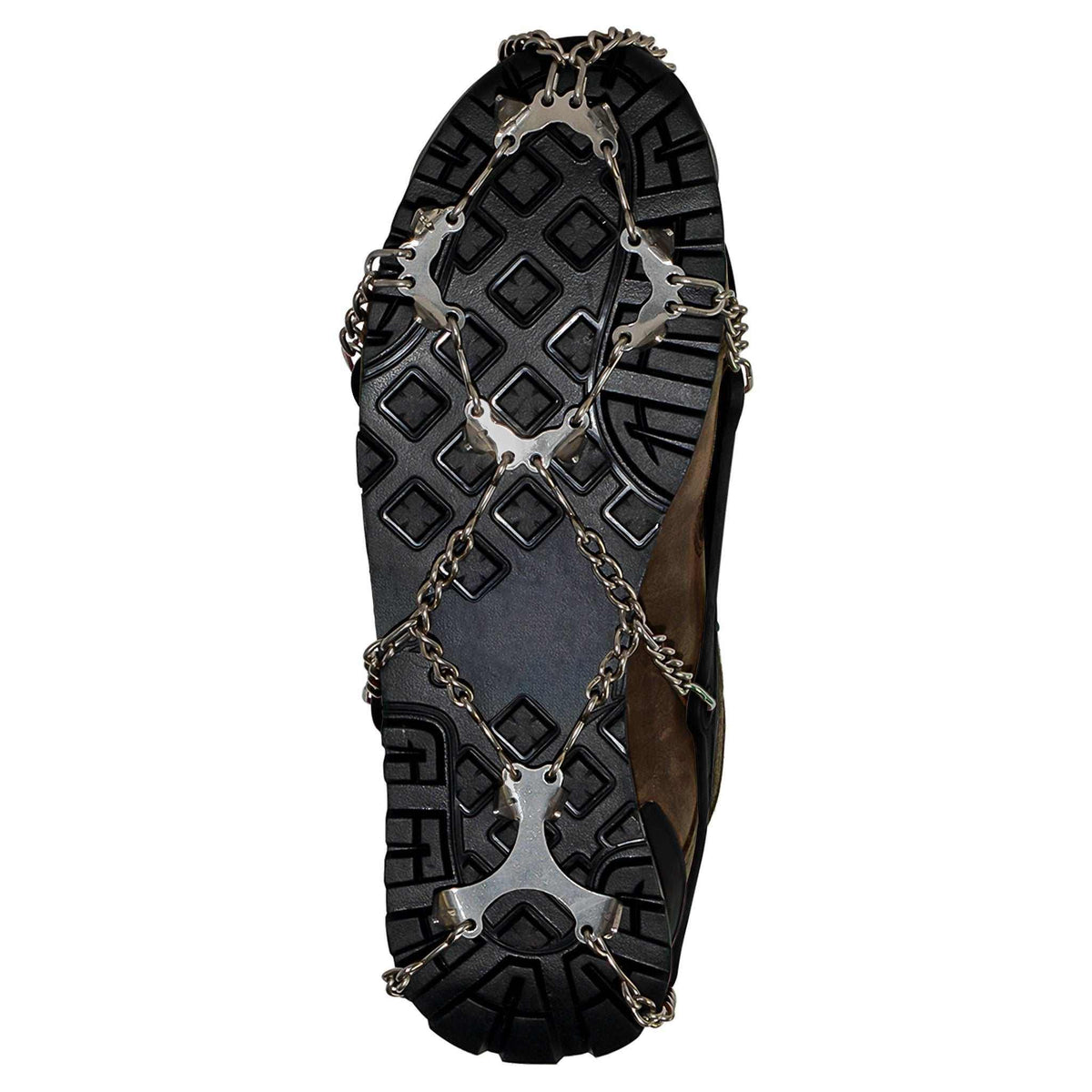
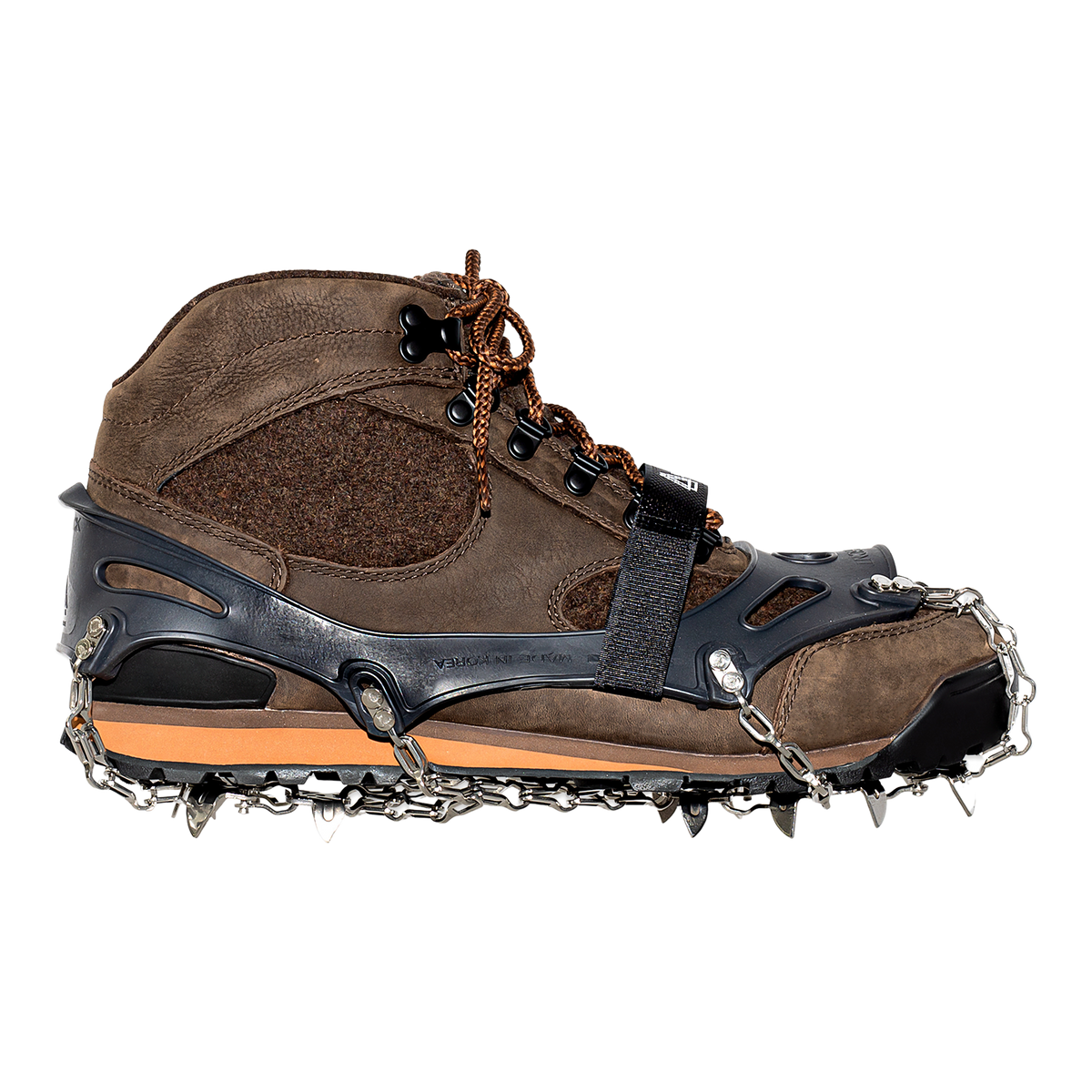
Yes, for the job they're designed for. The reason is simple physics. A rubber sole grips by friction, and ice has very little friction. A metal stud or spike doesn't rely on friction. It presses into the ice and anchors your step, the same way a tire stud or a skate blade does.
There's also some research behind it, not just marketing:
- A randomized trial in older adults. A 2005 study in the Journal of the American Geriatrics Society randomly assigned fall-prone people aged 65 and over to wear a slip-on traction device or their usual winter footwear outdoors through a winter. The usual-footwear group had 43 outdoor falls. The traction group had 19. Minimally injurious falls were 10 versus 1. One honest caveat: the researchers noted that many of the traction group's falls happened when people weren't wearing the device. It's one study, with about a hundred people, but it's a real controlled trial.
- Lab testing. When Consumer Reports tested four sets of slip-on ice cleats on a rink, it found all four "improved on the traction that running shoes provide."
What cleats don't do: they don't help much on deep, soft snow, they don't make thin lake ice safe to walk on, and they don't turn a rushed, phone-in-hand walk into a safe one.
Why your boots might not be enough
The obvious objection is "I have good winter boots." Maybe you do. But winter boots are mostly designed for warmth and snow, not glare ice.
KITE, the research institute at Toronto Rehab (part of University Health Network), tests winter footwear in its WinterLab on a tilting floor made of real ice. People walk up the slope while it gets steeper, until they slip. According to the UHN Foundation, "approximately 67 per cent of all footwear tested through Rate My Treads does not reach the minimum" angle of 7 degrees, and fails the test. In other words, about two out of three boots tested failed a basic slip test on ice.
There are good boots out there. KITE's Rate My Treads site lists the ones that pass. If you own a pair that rates well and your walking is mostly short and cleared, you may not need cleats at all.
How common are falls on ice in Canada?
Common enough to show up clearly in hospital data.
- According to the UHN Foundation, more than 21,000 Ontarians visit an emergency room each winter because of slips and falls on ice and snow.
- CBC reported Canadian Institute for Health Information figures showing Saskatchewan averaged 43.4 hospitalizations per 100,000 people from falls on ice between 2011 and 2016, the highest of any province.
And the temperatures we live with don't help. A 2018 study led by Daniel Bonn at the University of Amsterdam and Mischa Bonn at the Max Planck Institute for Polymer Research found that friction on ice was lowest at about –7 °C. That's an ordinary winter day across most of Canada. Wet ice near 0 °C, on thaw days, is slick in a different way. Our guide on how to walk on ice gets into the science.
The honest downsides of ice cleats
Here's what nobody puts on the box.
You have to take them off indoors
Metal on tile, marble, polished concrete and smooth wood is slippery, and it can scratch floors. That means stopping at the door of every store, office and friend's house. For some people this is a minor habit. For others, it's the reason the cleats stay in the closet.
They're awkward on long stretches of bare pavement
Spikes are made for ice. On dry concrete they feel less stable, they're noisy, and they wear down faster. If your walk is 90% bare sidewalk with a few icy patches, you'll be tempted to skip them. Low-profile cleats help, but no cleat feels as natural as a bare boot on dry ground.
Fit can be fiddly
A cleat that's too small pops off at the heel. One that's too big slides around under your sole. Putting them on over bulky winter boots takes a minute and some hand strength, which can be a real barrier for older people or anyone with arthritis. Sitting down to put them on helps. So does picking the right size for your boot, not your foot. Our guide on how to fit ice cleats covers it.
They wear out
Rubber harnesses can stiffen and crack in deep cold, and studs wear down, especially on pavement. Expect to replace a well-used pair eventually. A harness rated for deep cold and stainless steel spikes last longer.
They're one more thing to remember
The best cleats in the world don't help if they're at home when you hit the ice. The 2005 study above found exactly that: a lot of falls in the cleat group happened when people weren't wearing them.
Who doesn't need ice cleats
Honestly, plenty of people:
- People who rarely see ice. If your winter is mostly rain and a few frosty mornings, a good pair of boots and some care may be enough.
- People who drive door to door. Heated garage, plowed lot, indoor parkade at work. You're on ice for seconds a day.
- People whose routes are reliably cleared and salted, and who own boots that test well for slip resistance.
- Anyone who knows they won't use them. Be honest with yourself. If stopping at the door to take them off is a deal breaker, you won't wear them.
Who probably does
- Daily walkers and commuters who cross icy sidewalks, bus stops and parking lots, especially in freeze-thaw cities like Calgary, where a chinook can turn a sidewalk into glare ice overnight.
- Dog walkers. You're out every day in every condition, often in the dark, with a leash pulling you sideways.
- Older adults, for whom a fall has bigger consequences. This is the group the 2005 trial studied.
- Outdoor workers, delivery drivers and anyone who has to go out regardless of conditions.
- Winter hikers, runners and anglers, who walk on packed trail ice and bare lake ice that no boot sole handles well.
The cost of a fall versus the cost of cleats
We won't invent a dollar figure for what a fall costs. It depends on who you are and what happens. What we can say is that a fall on ice can mean an emergency room visit, a broken wrist or hip, a concussion, time off work, or weeks of not being able to do the things you like doing. In Ontario alone, more than 21,000 people end up in an emergency room each winter after slipping on ice and snow.
Ice cleats, by comparison, run from about $26 to $80 a pair. Here's our range, so you can see where you'd land:
| If you mostly... | Consider | Price (CAD) |
|---|---|---|
| Walk sidewalks, driveways and parking lots | City Spikes: 10 steel spikes, slip-on | $26 |
| Commute on mixed pavement and ice | Urban Spikes: low profile, carry case | $45 |
| Walk the daily commute and want dry feet too | Winter Commuter Pack: City Spikes plus waterproof socks | $55 |
| Need a locked-in fit for lifting, shovelling or rough ground | Mount Tracks: 13 stainless spikes, Velcro strap | $60 |
| Hike, walk dogs or ice fish | Ice Spikes: 15 mm stainless spikes, harness tested to –40 °C | $65 |
| Run on trails and packed snow | Trail Spikes: flexible chain | $80 |
| Outfit the household | Family Winter Traction Pack | $118 |
If you decide to try a pair, start cheap and simple. A light slip-on cleat for town is the most useful pair for most people. You can always add trail spikes later. We offer free shipping across Canada on orders over $100 and 14-day returns, so if they don't fit your boots or your routine, send them back. For ranked picks, see best ice cleats in Canada, and for city-by-city advice, ice cleats by city.
How to get your money's worth
- Keep them where you'll use them: by the front door, in the car, in your work bag.
- Put them on sitting down, before you step onto the ice.
- Take them off at the door every time.
- Rinse off salt and let them dry so the metal and rubber last.
- Keep walking carefully. Short steps and free hands still matter.
Frequently asked questions
Do ice cleats really work?
Yes, on ice. Metal studs or spikes press into the surface instead of relying on friction. A 2005 randomized trial in older adults found fewer outdoor falls among people assigned a slip-on traction device, and lab testing has found cleats improve grip over regular shoes. They help much less in deep, soft snow.
Are ice cleats worth it?
They're worth it if you regularly walk on ice you can't avoid, such as sidewalks, parking lots, trails or frozen lakes. They're less useful if you rarely see ice or drive door to door.
What are the downsides of ice cleats?
You have to take them off indoors, they're slippery on tile and smooth floors, they feel awkward and wear faster on bare pavement, and they can be fiddly to fit over bulky boots.
Can I just buy better winter boots instead?
Possibly. Some boots pass KITE's WinterLab slip test, but about two-thirds of footwear tested through its Rate My Treads program fails. If you choose boots, check their rating. On glare ice, metal still has the advantage of biting into the surface.
Can you wear ice cleats on pavement?
Yes, for short stretches, but they wear faster and feel less stable on dry concrete. If your route is mostly bare, choose a low-profile pair or take them off when the ice ends.
Are ice cleats good for seniors?
They can be. The 2005 trial studied adults 65 and over and found fewer outdoor falls in the group given traction devices. Choose a pair that's easy to put on, put them on sitting down, and always remove them before going indoors.
Sources: ScienceDaily, on McKiernan, Journal of the American Geriatrics Society (2005); Consumer Reports (2016); UHN Foundation, "How to choose the right snow boots"; KITE Rate My Treads; UHN Foundation, "Preventing injuries before they happen"; CBC News; Phys.org, "The slipperiness of ice explained" (2018).
The bottom line
Ice cleats aren't for everyone, and they're a little annoying to live with. But if your winter puts you on ice you can't walk around, they're one of the cheapest, simplest ways to stay on your feet. Browse the full winter traction collection, or read our complete winter traction guide to work out which type fits your winter.

Leave a comment
All comments are moderated before being published.
This site is protected by hCaptcha and the hCaptcha Privacy Policy and Terms of Service apply.